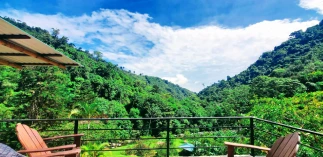
High in the Costa Rican mountains, our retreat offers stunning views, refreshing breezes, and the soundtrack of a vibrant avian community. But venture a little lower, to the wetland areas that dot the foothills, and you might encounter a much shyer resident: the Yellow-breasted Crake.
Make the most of your stay: continue with Hiking Trails Costa Rica.
This sparrow-sized crake is a true master of camouflage. Its back mimics the rich, earthy tones of fallen leaves and mud with buffy-brown or chestnut feathers adorned with black and white streaks and bars. The flanks continue the black and white barring theme, making the Yellow-breasted Crake practically disappear amongst the reeds.
But look a little closer, and a flash of sunshine peeks through. The bird’s neck and breast are a warm buff, almost yellow, that gives it its name. This bright patch is further accentuated by a unique facial pattern – a bold, white, broken eyebrow framed dramatically by a blackish crown and a strong black eye-stripe that forks dramatically at the eye.
Seeing a Yellow-breasted Crake, however, is a feat in itself. These are incredibly shy birds, preferring the dense cover of freshwater marshes, ponds, and areas choked with water lilies and other emergent vegetation. If you’re lucky enough to spot one, it will likely be thanks to a sudden burst of movement – the crake will scurry across floating vegetation pads, its long, yellow-orange legs propelling it forward.
Flight is usually a last resort for the Yellow-breasted Crake. When flushed, it will take off in a weak, almost comical manner, with its yellowish legs dangling beneath its body. But don’t be fooled by the ungainly appearance – the Yellow-breasted Crake is a strong flier, capable of covering long distances when necessary.
While you might not see them every day, their presence can be detected by their vocalizations. Listen for a series of loud, piercing whistles, often described as a “kee-kee-kee” or a “chur-chur-chur.” These calls, particularly active at dawn and dusk, are the Yellow-breasted Crake’s way of communicating with one another.
The Yellow-breasted Crake’s diet consists mainly of insects, small crustaceans, and seeds found in the wetland areas they inhabit. They are solitary birds for most of the year, except during breeding season. The male constructs a platform nest amongst the dense vegetation, and the female lays up to 10 eggs. Both parents take turns incubating the eggs and feeding the chicks.
The Yellow-breasted Crake has a relatively large range, spanning most of Central and South America, with scattered populations in the Caribbean islands. However, due to habitat loss and degradation, their populations are considered vulnerable in some areas. Here at our Costa Rican retreat, we are committed to conservation efforts that protect the wetlands these fascinating birds call home.
So, the next time you’re exploring the lower areas around our mountain retreat, keep an eye out for a splash of sunshine amidst the reeds. With a little patience and a keen eye, you might just be lucky enough to catch a glimpse of the elusive Yellow-breasted Crake.
For more information, please view our comprehensive guide about the birds of Costa Rica