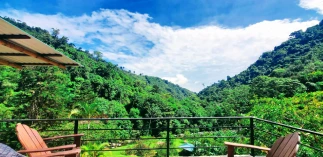
Far in the mountains of Costa Rica, where the emerald embrace of the rainforest thins to give way to the freshness of conifers, a discreet songbird takes center stage: the Gray-cheeked Thrush. Unlike its brightly feathered neighbors, this thrush favors subtlety, dressed in soft gray and brown plumage that blends perfectly into the mossy undergrowth. But don’t be fooled by its sober appearance – the Gray-cheeked Thrush is a captivating resident of our high-altitude refuge, offering a glimpse into the wonders of long-distance migration.
Envie d’en savoir plus ? Commencez ici : Sentiers de randonnée Costa Rica.
A Master of Camouflage:
Spotting a Gray-cheeked Thrush can be a delightful challenge. Its plumage is a symphony of soft browns on top, transitioning to a pale grayish-white underneath, with subtle streaks adorning the chest. Unlike other thrushes of the Catharus genus, they have no prominent facial markings, their grayish face lacking the buff eye-ring or warm tones seen in their counterparts. This cryptic coloration allows them to blend into the dappled light filtering through the forest canopy, making them masters of camouflage.
A Song that Travels the Mountains:
While their appearance is discreet, the song of the Gray-cheeked Thrush is not. Their ethereal melody, described as a series of descending metallic-sounding phrases, resonates through the mountain forests. Often heard in the late evening as they perch atop trees, their song adds a touch of magic to the cool mountain air. For the patient observer, this melodic call can be a valuable clue, revealing their presence even when they remain hidden in the dense foliage.
A Long and Difficult Journey:
The Gray-cheeked Thrush is a champion of long-distance migration. Breeding in the northernmost regions of North America and eastern Siberia, they undertake a remarkable journey south, with some individuals traveling over 3,000 kilometers to reach their wintering grounds in the Amazon basin. During their migratory stopovers in Costa Rica, they can be found at high altitudes, inhabiting dense coniferous forests and groves of willows and alders. Here, they refuel on insects gleaned from the forest floor and berries found in the undergrowth.
A Fleeting Treasure of the Highlands:
The Gray-cheeked Thrush may not be a permanent resident of our mountain refuge, but its presence adds a touch of wonder to the experience. Its shy nature and subtle beauty make it a prized bird for amateur ornithologists, while its captivating song reminds us of the interconnectedness of the natural world. So, the next time you explore the cooler, coniferous highlands of our refuge, listen for the ethereal melody of the Gray-cheeked Thrush – a fleeting glimpse into the fascinating world of long-distance aerial journeys.
Pour plus d’informations, veuillez consulter notre guide complet sur les oiseaux du Costa Rica.